Sống Tỉnh Thức
01/2026
FROM THE EARTH’S TRAUMA TO THE HUMAN PSYCHE
After returning, my first step wasn't just to speak more about climate change, but to upgrade my own "operating system." The nervous system, the breath, the capacity for endurance and recovery—all must be recalibrated to be compatible with an Earth that no longer follows the old rules. A warming planet and an unstable climate demand that humanity evolves not just technologically, but internally. Not to fight nature, but to learn how to live in harmony with its new state. What I am preparing is not just a response for now; it is a lifeboat for an entire future generation.
Today, Hanoi’s daytime temperature plummeted to 9°C.
It is a cold not unfamiliar to Northern Vietnam, yet it was deep enough to pierce through the layers of time and awaken a very different memory within me.
This chill didn’t just rest on the skin. It seeped through fabric, touched the marrow, and forced the body into a sharp, startled breath. Almost instantaneously, the Himalayas returned.
I remember vividly standing at those towering altitudes—where the temperature drops dozens of degrees below zero and the wind doesn't merely blow; it slices. No protective gear. No familiar shields of civilized life. Just a raw body exposed to the elements, held together by a fragile thread of faith that I could endure 60 minutes of meditation, even as my body screamed in alarm.
That wasn't an imagined fear. It was the very real helplessness of the flesh failing to adapt to such severity. While the mind tried to remain calm, the nervous system had already retreated into survival mode. Every cell understood: if awareness slipped, the boundary between "endurance" and "damage" was perilously thin.
As a researcher of the mind and psychology, I know: that exact moment etched a profound mark into my subconscious.
In psychology, trauma is not only born from grand acts of violence or loss. It can stem from any experience the nervous system perceives as a "threat beyond its capacity to cope." When the body undergoes a terror of such magnitude, the brain memorizes the environmental conditions and automatically installs a defense mechanism. The next time those conditions reappear, the reaction triggers—often faster than conscious thought.
For me, the cold became that trigger.
It took nearly six months after returning from the Himalayas before I could sleep with the air conditioning on without my heart racing and my breath shortening. It took much longer to let my skin touch a cold breeze without subconsciously reaching for a coat or a scarf. That wasn't weakness; it was my nervous system learning to believe it was safe again.
And today, over a year has passed.
Hanoi is exceptionally cold. I stepped outside, letting the chill touch my skin, allowing my body to observe its own reactions. There was still a slight hesitation. A fleeting memory. But it was different. I didn't panic. I didn't recoil. I stood still, took a long breath, and realized: my body had learned to walk through the fear, rather than hide from it.
At that moment, my thoughts turned to the Earth.
Over the past year, the global climate has shifted in ways that are increasingly extreme and erratic. A warming planet doesn't mean everywhere gets balmier. On the contrary, an unstable climate system amplifies extremes: while some regions face record heat, others are submerged in deep freezes and snowfall unseen in decades.
Regions like Russia, Canada, and Finland have recorded snow levels unprecedented in 124 years. This isn't because the climate is "cooling back down," but because atmospheric currents are so disrupted that cold air is trapped longer in certain zones. Simultaneously, warming oceans fuel weather systems, pushing natural disasters to thresholds previously seen only in forecast models.
THE WORLD’S LARGEST ICEBERG: A FINAL COUNTDOWN
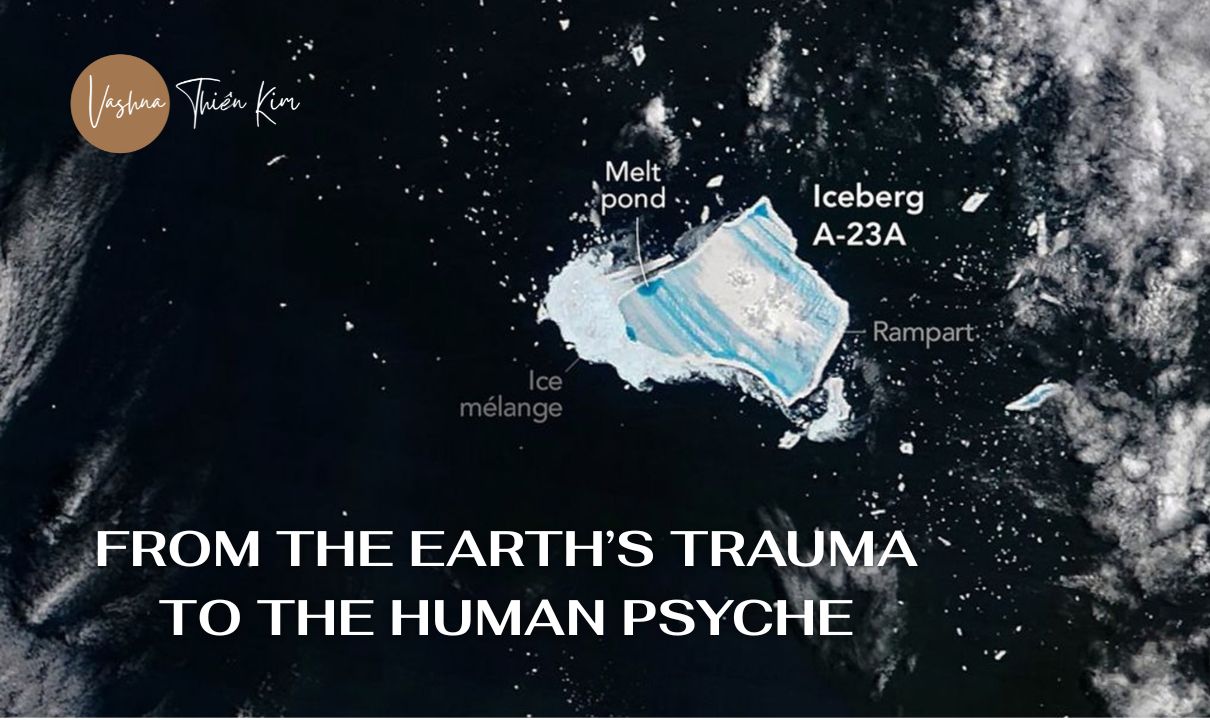
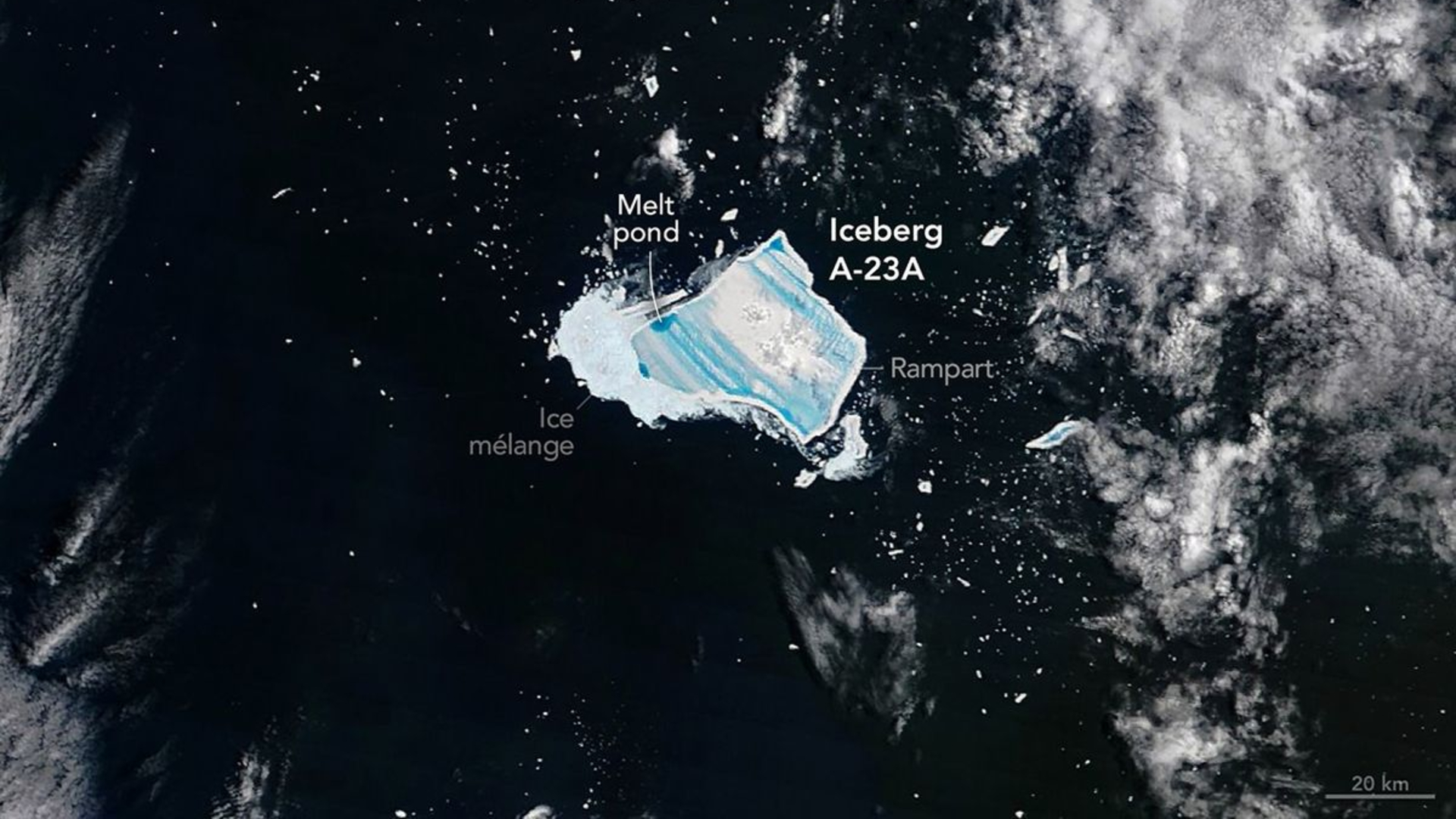
The rapid disintegration of the A23a iceberg is a signal we cannot afford to ignore. When an ice mass that remained stable for decades can vanish in a matter of weeks, it signals that our global cryosphere is approaching an irreversible tipping point. Melting ice is not just a story of rising sea levels; it is a sign that the Earth is losing its ability to self-regulate.
Much like a human body after trauma. When defense mechanisms are overwhelmed, reactions become more extreme and harder to control.
On January 20, 2026, a brief news report left me in silence: A23a is in its final weeks.
Having calved from the Filchner Ice Shelf in 1986, A23a spanned 4,170 km² and endured for nearly 40 years. But by mid-January 2026, satellite data revealed its main body had shrunk to just 506 km²—less than an eighth of its original size.
The true concern lies in the velocity of its collapse. In just three weeks—from late December 2025 to January 14, 2026—A23a lost nearly 47% of its mass. This is not the slow, rhythmic melting of a natural cycle; this is an accelerated fragmentation.
The cause is clear: sea temperatures around the iceberg are over 3°C above freezing. The Antarctic summer sun creates blue meltwater ponds on the surface, which drain into crevasses, creating internal pressure that shatters the structure. Combined with currents pushing it into warmer waters, A23a has entered an irreversible collapse.
A23a’s demise is a vivid testament that the Earth’s energy imbalance has breached its old equilibrium. It is the consequence of warming oceans, accumulated greenhouse gases, and the simultaneous weakening of our natural buffers—forests and ice. When these "buffers" vanish, the climate can no longer absorb shocks. Extremes become more frequent, more violent, and less predictable.
A23a is disappearing.
And what is melting along with it is the safety buffer the Earth once had to heal itself.
KARMA AND CONSEQUENCE
The chain of causality is undeniable. This is no longer a "future" problem. It is directly impacting our health, our livelihoods, and our sense of security today—from abnormal freezes to heatwaves that exceed physiological limits.
A year after the Himalayas, standing in the 9°C chill of Hanoi, I understand one thing clearly: resilience does not come from denying trauma, but from looking directly at it, understanding its mechanics, and proactively changing how we live. We must stop pushing the system—whether it is our body or our planet—beyond its limits.
Climate change is no longer a distant scientific concept. It "touches" every human being, just as the cold touched my memory today. If we want time to adapt, choosing to reduce pressure on the climate system is no longer a moral option; it is the minimum requirement for survival.
THE EYES OF THE WITNESS: BETWEEN SORROW AND AWAKENING
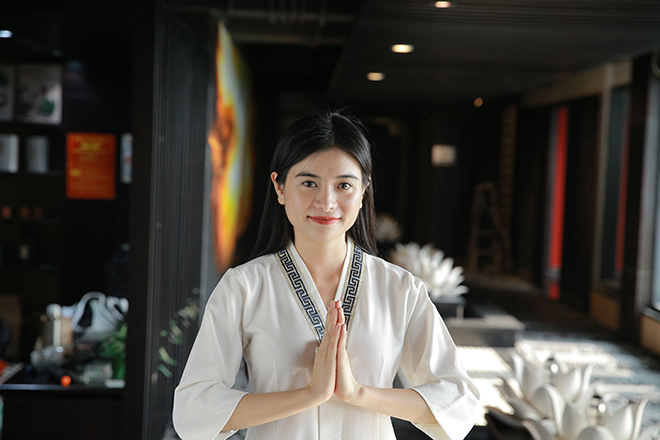
Looking back at this photo, I ask myself: "Why do your eyes look so heavy with sorrow?"
Perhaps it wasn't just the exhaustion of a human who had crossed the limits of physical endurance. Perhaps it was the helplessness of touching the limits of nature—limits that have been pushed so far that many future consequences seem irreversible.
Those eyes in the photograph are both sad and awake.
Sad, because they see the price of delay.
Awake, because they know that as long as we have time, we cannot afford to stand still.
The question remains: Do we truly realize the gravity of what we are about to face?
For me, the answer is not found in panic or pessimism. It is found in choice.
I believe the story hasn't ended. There are still parts we can change if we are clear-headed enough to start—and determined enough to follow through. But that change cannot only be external. It must begin from within.
After returning, my first step wasn't just to speak more about climate change, but to upgrade my own "operating system." The nervous system, the breath, the capacity for endurance and recovery—all must be recalibrated to be compatible with an Earth that no longer follows the old rules.
A warming planet and an unstable climate demand that humanity evolves not just technologically, but internally. Not to fight nature, but to learn how to live in harmony with its new state. What I am preparing is not just a response for now; it is a lifeboat for an entire future generation.
Vashna Thien Kim

.jpg)